Affiliate Disclosure: This article contains affiliate links. If you purchase through these links, we may earn a commission at no extra cost to you. We only recommend tools we’ve thoroughly evaluated for small business use cases.
Quick Verdict: Klaviyo Review for Small Business
Best for: E-commerce small businesses that want serious email and SMS marketing automation tied directly to purchase data.
Standout feature: Deep Shopify/WooCommerce integration with revenue attribution on every campaign and flow.
Skip it if: You’re not in e-commerce, your list is under 500 contacts and you need something free, or you want a general-purpose CRM instead of a marketing platform.
Overall rating: ⭐⭐⭐⭐½ (4.5/5)
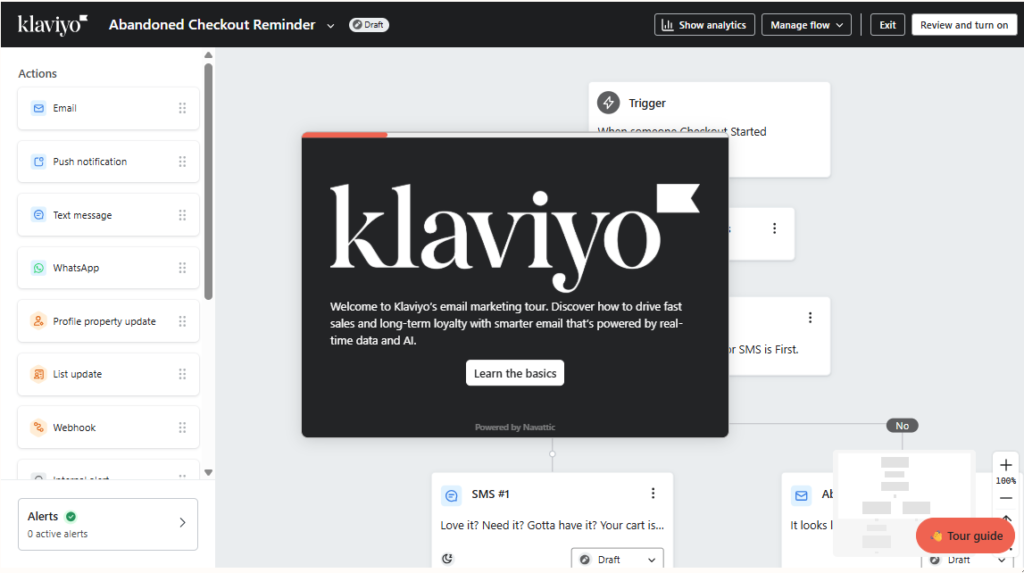
Table of Contents
Klaviyo Review: What Is Klaviyo?
This klaviyo review cuts straight to what small business owners actually need to know: whether the platform is worth your money, your time, and the learning curve. Klaviyo is an email and SMS marketing automation platform built specifically for e-commerce. Unlike general-purpose email tools that treat your store as an afterthought, Klaviyo was designed from the ground up to connect marketing activity to revenue data — down to the dollar.
Klaviyo now powers over 150,000 businesses globally and integrates natively with Shopify, WooCommerce, BigCommerce, Magento, and dozens of other e-commerce platforms. Its core premise is simple: every email, every SMS, every automation flow should be traceable to real purchases. If that’s how you want to run your marketing, Klaviyo is built for you.
But “built for e-commerce” also means it’s not a fit for service businesses, SaaS, agencies, or anyone whose revenue isn’t tied to an online store. Before you commit, you need a clear picture of what you’re getting — and what you’re not.
Klaviyo Review: Pricing Breakdown
Klaviyo splits pricing into two separate pieces: a contact-based Email plan, and usage-based pricing for SMS, MMS, WhatsApp, and RCS messaging. One detail that catches people off guard: since a February 2025 billing change, the Email plan charges based on all active profiles in your account — including contacts who never opted in to marketing but could still be emailed — not just the contacts you actively email each month. Check your active profile count under Account Settings → Billing before estimating your cost.
Free Plan
Klaviyo’s free plan covers up to 250 active profiles, 500 email sends per month, and $5 of mobile messaging credit to test SMS campaigns. There’s no time limit — it’s a permanent free tier, not a trial.
Email Plan (Paid Tiers)
| Active Profiles | Email Plan (Monthly) | Approx. Email Sends/Month |
|---|---|---|
| Up to 250 | Free | 500 |
| 251–500 | $20 | ~5,000 |
| 501–1,000 | $30 | ~10,000 |
| 1,001–1,500 | $45 | ~15,000 |
| 1,501–2,500 | $60 | ~25,000 |
Prices are accurate as of the date of this article but are subject to change. Always verify current pricing on the tool’s official pricing page before making a decision.
SMS, MMS, and Messaging Pricing
Unlike the Email plan, mobile messaging isn’t a flat monthly tier — it’s usage-based. You pay per message sent, and the rate depends on channel and destination country. As of this writing, U.S. toll-free rates run roughly $0.009 per SMS and $0.033 per MMS, plus carrier fees, with separate (often lower) rates for WhatsApp and RCS. As an example, a plan built around 2,900 SMS and 1,200 MMS sends per month to U.S. numbers comes out to approximately $90/month before carrier fees. Klaviyo’s own pricing calculator lets you plug in your actual expected volume and destination country for an exact quote — there’s no way to give a single universal SMS price, since it scales with how many messages you actually send.
Klaviyo does not offer significant annual discounts on the Email plan — pricing scales primarily by active profile count, not billing period. The free plan is functional for very early-stage stores, but you’ll hit the ceiling fast. Budget carefully and audit your active profile list quarterly; unengaged and non-opted-in contacts you haven’t suppressed still count toward your bill.
You can start a Klaviyo free trial here and explore the platform before committing. For a detailed look at what each tier unlocks, check the Klaviyo pricing page.
Klaviyo Review: Features That Matter for Small Business
1. Email Automation Flows
Flows are Klaviyo’s automation engine. You set triggers — a purchase, abandoned cart, signup, browse behavior — and build branching sequences that respond to what customers actually do. The visual flow builder is intuitive, and Klaviyo ships dozens of pre-built templates so you’re not starting from scratch. The key differentiator is that flows can branch based on purchase history, product category, predicted lifetime value, and more — logic that most competing tools can’t match without custom development.
2. Segmentation
Klaviyo’s segmentation is the strongest in the email marketing category for e-commerce. You can build segments from 200+ data points including purchase frequency, average order value, product affinity, predicted spend tier, and engagement history. Segments update in real time, which means your “high-value customer” segment is always accurate — not a snapshot from last week’s export. This is the feature that justifies Klaviyo’s price premium over basic tools like Mailchimp.
3. Revenue Attribution
Every campaign and flow shows you exactly how much revenue it generated — not just opens and clicks. You get a dashboard view of revenue attributed to email vs. SMS vs. specific flows. For a small business owner trying to justify marketing spend, this is genuinely useful. You know whether your abandoned cart flow is making you money, not just whether people are opening it.
4. SMS Marketing
Klaviyo’s SMS channel is fully integrated with email, not bolted on. You can build flows that send an email first, then follow up with SMS if the email wasn’t opened — all within the same flow builder. SMS compliance (opt-in management, quiet hours) is handled automatically. SMS is billed by usage rather than a flat monthly add-on, so cost scales directly with how many messages you actually send.
5. A/B Testing
Klaviyo supports A/B testing for subject lines, email content, and send times across both campaigns and flows. Flow A/B testing is particularly valuable — you can test two entirely different automation sequences against each other and let the platform determine a winner based on revenue, not just clicks. Most small business owners overlook this feature, but it compounds over time into meaningful revenue improvements.
6. AI and Predictive Analytics
Klaviyo’s AI layer includes predicted lifetime value, churn risk scores, and optimal send-time predictions at the individual contact level. These aren’t marketing gimmicks — the predicted CLV model is trained on actual purchase data and can be used as a segmentation filter. If you want to run a win-back campaign for customers who are predicted to churn in the next 90 days, you can build that segment and run it in under five minutes.
7. Integrations
Klaviyo connects natively with Shopify, WooCommerce, BigCommerce, Magento, Squarespace Commerce, Wix, ReCharge (subscriptions), Yotpo (reviews), Gorgias (customer support), and over 300 other tools. The Shopify integration in particular is best-in-class — bidirectional data sync, real-time event tracking, and no manual CSV exports required. If you’re on Shopify, Klaviyo is the default choice for a reason.
Who Klaviyo Is For
This klaviyo review found the platform is most relevant for e-commerce operators — specifically small businesses running online stores with an existing customer base. It delivers maximum value when you have at least 500 contacts, meaningful purchase history, and a need to personalize messaging at scale.
Ideal fit:
- Shopify or WooCommerce stores with $10K+ monthly revenue
- Brands running product launches, flash sales, or seasonal promotions
- Stores with multiple product categories that need intelligent segmentation
- Businesses looking to build out post-purchase retention sequences
- E-commerce operators already paying for SMS marketing and wanting consolidation
Poor fit:
- Service businesses (consulting, cleaning, landscaping, legal)
- SaaS companies or subscription businesses not on Shopify/WooCommerce
- Businesses under 250 contacts who don’t expect rapid list growth
- Anyone who needs a CRM with pipeline management — Klaviyo is not a CRM
- Nonprofits or content creators without an e-commerce revenue stream
If you run a service-based small business and need a full marketing-plus-CRM stack instead, our best CRM for small business roundup covers tools built for that use case — including GoHighLevel, which pairs marketing automation with a full sales CRM in a way Klaviyo intentionally doesn’t.
Klaviyo Review: Pros and Cons
Pros
- Best-in-class e-commerce integration: Native Shopify sync is real-time and requires zero manual maintenance.
- Revenue attribution built in: You always know which flows and campaigns are making money.
- Segmentation depth: 200+ data points, real-time updates, and predictive attributes that most tools don’t offer.
- SMS and email in one platform: Unified flows and reporting reduce the tool sprawl problem.
- Pre-built flow library: Abandoned cart, welcome series, post-purchase, win-back — all ready to deploy and customize.
- Deliverability: Klaviyo has strong sender reputation infrastructure, and their deliverability support is proactive, not reactive.
- Scalable: Works for a 500-contact startup and a 500,000-contact enterprise without switching platforms.
Cons
- Price scales with your whole list, not just who you email: Since 2025, unsuppressed non-opted-in contacts count toward your bill. Quarterly list cleaning is essentially mandatory.
- Learning curve: The platform is powerful but not beginner-friendly. Expect 2–4 weeks before you’re running confidently.
- Not for non-e-commerce: If your revenue isn’t product-based, you’re paying for features you’ll never use.
- No built-in CRM: Contact management is marketing-focused, not sales-pipeline-focused.
- Customer support limited on lower tiers: Email-only support on the base plan. Phone support requires a higher spend threshold.
- SMS pricing requires calculation: There’s no flat monthly SMS tier — you’ll need to run your own numbers through Klaviyo’s usage calculator to know your real cost.
Klaviyo Review: vs. Competitors
Here’s how Klaviyo stacks up against the three tools it’s most commonly evaluated against for e-commerce: Mailchimp, ActiveCampaign, and Drip.
| Feature | Klaviyo | Mailchimp | ActiveCampaign | Drip |
|---|---|---|---|---|
| E-commerce focus | ⭐⭐⭐⭐⭐ | ⭐⭐⭐ | ⭐⭐⭐ | ⭐⭐⭐⭐ |
| Segmentation depth | ⭐⭐⭐⭐⭐ | ⭐⭐⭐ | ⭐⭐⭐⭐ | ⭐⭐⭐⭐ |
| Revenue attribution | ✅ | ✅ (limited) | ✅ (limited) | ✅ |
| SMS marketing | ✅ (usage-based) | ✅ | ✅ | ✅ |
| CRM functionality | ❌ | ❌ | ✅ | ❌ |
| Shopify integration | ⭐⭐⭐⭐⭐ | ⭐⭐⭐ | ⭐⭐⭐ | ⭐⭐⭐⭐ |
| Predictive analytics | ✅ | ❌ | ✅ (partial) | ✅ (partial) |
| A/B testing (flows) | ✅ | ❌ | ✅ | ✅ |
| Best for | E-commerce | Beginners | Service/SaaS | E-commerce |
⚠️ Pricing shown reflects rates at time of publication. SaaS pricing changes frequently — verify current pricing on each tool’s website before committing.

vs. Mailchimp: Mailchimp wins on simplicity and price for very small lists. Klaviyo wins on segmentation, automation depth, and e-commerce revenue tracking at every list size above 500 contacts. Once you’re running a real store, the Mailchimp ceiling becomes a limitation. Our ActiveCampaign vs Mailchimp comparison covers more of the nuance around what Mailchimp can and can’t do.

vs. ActiveCampaign: ActiveCampaign is the better choice if you need CRM pipeline features, B2B lead nurturing, or a service-business automation setup. Klaviyo wins for e-commerce businesses where purchase data drives marketing logic. For a deeper look at ActiveCampaign’s full feature set, the ActiveCampaign review for small business covers it in detail.
vs. Drip: Drip is Klaviyo’s closest competitor and a legitimate alternative for e-commerce operators who want simpler pricing or don’t use Shopify as their primary platform. Klaviyo’s predictive analytics and SMS integration give it a meaningful edge for most use cases, but Drip’s pricing is more predictable at scale.
Not running e-commerce at all? Klaviyo isn’t really built to compete with an all-in-one platform like GoHighLevel, which pairs marketing automation with a full CRM, funnels, and pipeline management for service businesses. If your revenue comes from booked jobs and client relationships rather than online checkout, that’s the more relevant comparison to make.
How to Get Started with Klaviyo
Getting Klaviyo up and running for a Shopify store takes less time than most owners expect. Here’s the practical sequence:
- Create your account: Start with the free plan to explore the interface before paying anything.
- Connect your store: Install the Klaviyo app in your Shopify or WooCommerce store. The sync pulls in historical orders, customers, and product catalog immediately.
- Enable pre-built flows: Activate the abandoned cart, welcome series, and post-purchase flows first. These generate revenue before you’ve built anything custom.
- Set up your signup forms: Klaviyo’s form builder handles email capture on your site. Connect it to a welcome flow so new subscribers get an automated introduction immediately.
- Build your first segments: Start with three core segments — active buyers (purchased in last 90 days), lapsed customers (no purchase in 120+ days), and high-value customers (top 20% by spend). These power your first targeted campaigns.
- Send your first campaign: Don’t overthink the first email. Test a simple product announcement to your active buyer segment and review the revenue attribution report after 48 hours.
- Audit and optimize weekly: Check flow performance every week for the first month. Klaviyo’s benchmarks by industry tell you how your open rates, click rates, and revenue per recipient compare to similar stores.
Most small businesses see the abandoned cart flow generate positive ROI within the first 30 days. That single automation typically pays for the subscription at the entry pricing tier.
For small businesses looking to extend automation beyond email and SMS, the best AI marketing tools for small business roundup covers complementary tools worth stacking alongside Klaviyo.
Klaviyo Review: FAQ
Is Klaviyo worth it for a small business with a small list?
A fair klaviyo review has to start here: if you have fewer than 250 contacts, the free plan gives you full access to test the platform. Beyond that, cost scales with your active profile count — the ROI question comes down to whether your automation flows are generating more than your monthly bill in recovered revenue. For most active e-commerce stores, the answer is yes within 30–60 days.
Does Klaviyo work with WooCommerce?
Yes. Klaviyo has a native WooCommerce plugin that syncs orders, customers, and products in real time. The integration is strong, though Shopify’s native Klaviyo connection is marginally tighter. WooCommerce store owners get 95% of the same functionality and all of the core automation capabilities.
How does Klaviyo compare to Mailchimp for e-commerce?
Mailchimp is easier to start with and cheaper at the lowest contact tiers. But Klaviyo’s segmentation depth, predictive analytics, and revenue attribution make it significantly more powerful for e-commerce once your store has traction. If you’re processing more than 50 orders per month, Klaviyo’s automation logic and reporting will outperform Mailchimp in measurable revenue terms.
Can I use Klaviyo for SMS marketing without email?
You can purchase SMS credits within Klaviyo, but the platform is primarily an email-first tool. SMS works best within Klaviyo as a complement to email flows — for example, sending an SMS follow-up to contacts who didn’t open an abandoned cart email. Using Klaviyo purely for SMS without email automation isn’t a cost-effective standalone approach for most small businesses.
What’s the biggest limitation of Klaviyo?
Any honest klaviyo review has to flag the billing model. Since the 2025 shift to active-profile billing, you pay for every contact that could theoretically be emailed — including people who never opted in to marketing, unless you’ve manually suppressed them. A list that grew through giveaways or unqualified signups can quietly inflate your bill. Regular list hygiene isn’t optional with Klaviyo the way it is with some competitors.
Does Klaviyo have a free trial?
Klaviyo’s free plan covers up to 250 contacts and 500 email sends per month with no time limit — it’s a permanent free tier, not a 14-day trial. This is more generous than many competitors. You can create a free Klaviyo account and run real automations before spending anything.
Is Klaviyo a CRM?
No. Klaviyo has robust customer profiles and contact data, but it’s a marketing automation platform, not a sales CRM. There’s no pipeline management, deal tracking, or sales activity logging. If you need both e-commerce marketing automation and a CRM, you’d run Klaviyo for marketing and a separate tool for sales. Our best CRM for small business guide covers the right sales tools to pair with a platform like Klaviyo.
Verdict: Klaviyo Review Final Recommendation
This klaviyo review lands in a clear place: if you run an e-commerce store on Shopify or WooCommerce with a real customer base and real purchase history, Klaviyo is the strongest email and SMS marketing platform available to you. Its segmentation, automation logic, and revenue attribution are genuinely best-in-class, and the pre-built flow library means you can generate ROI before you’ve touched a single custom setting.
The caveats are equally clear. Klaviyo is not for service businesses, not for SaaS, and not for anyone who needs a CRM. It scales expensive as your active profile list grows, and it demands more setup time than beginner-friendly tools like Mailchimp. If those trade-offs match your situation, you’re looking at a platform that can grow with your store from $50K to $5M in annual revenue without requiring a platform migration.
For a small business in e-commerce that’s serious about converting customer data into revenue, the answer is simple: get started on the free plan, activate your abandoned cart flow, and watch whether it pays for itself. It almost always does.
Ready to try it? Start your free Klaviyo account here or review the Klaviyo pricing page to find the right tier for your list size.