Affiliate disclosure: This article contains affiliate links. If you purchase through links on this page, I may earn a commission at no extra cost to you. I only recommend tools I’ve researched thoroughly and believe are genuinely useful for small businesses.
Quick Answer
ActiveCampaign is the better choice for small businesses that run email-driven marketing and need serious automation without enterprise pricing. HubSpot’s free CRM is one of the most useful free tools in the category, but once you need real marketing automation, the pricing jumps sharply. If you’re a service business looking for CRM, email, and automation in one platform, GoHighLevel is worth comparing before you commit to either. The bottom line on ActiveCampaign vs HubSpot: your primary use case — email automation or CRM — should make the decision for you.
Table of Contents
Why This Comparison Matters for Small Businesses
Most small businesses evaluating ActiveCampaign vs HubSpot are trying to answer the same question: do I need a marketing automation platform or a CRM platform — and can one tool do both without breaking the budget?
The honest answer is that these two products are built from opposite directions. ActiveCampaign was built as an email automation platform first. The CRM exists and works, but the product’s identity is in sequences, behavioral triggers, and segmentation logic. HubSpot was built as a CRM first. The free tier reflects that — it’s genuinely one of the best free CRMs available. But when you need marketing automation that goes beyond basic email sends, HubSpot’s pricing model becomes a problem.
That gap — where each platform was built from — is what determines which one is right for your business. This ActiveCampaign vs HubSpot breakdown covers email automation, CRM capability, deliverability, landing pages, reporting, ease of use, and pricing so you can make the call without second-guessing it later.
Comparison Table: ActiveCampaign vs HubSpot
| Feature | ActiveCampaign | HubSpot |
|---|---|---|
| Best for | Email-first marketing + automation | CRM-first businesses with sales teams |
| Starting price | From $15/month | Free CRM; Marketing Hub from $15/month |
| Free plan | ❌ No (14-day trial) | ✅ Yes |
| Email automation | ⭐⭐⭐⭐⭐ Best in class | ⭐⭐⭐ Limited until Professional |
| CRM | ⭐⭐⭐ Functional | ⭐⭐⭐⭐⭐ Best in class |
| Deliverability | ⭐⭐⭐⭐⭐ Industry leading | ⭐⭐⭐⭐ Solid |
| Landing pages | ✅ Plus plan and above | ✅ All paid plans |
| Reporting | ⭐⭐⭐⭐ Strong | ⭐⭐⭐⭐⭐ Best on Professional |
| Ease of use | Moderate learning curve | Easier to start |
| Pricing transparency | Straightforward | Complex — steep jump at Professional |
| GoHighLevel alternative | ✅ For service businesses | ✅ For service businesses |
Pricing verified at time of writing — check the current pricing pages before purchasing as SaaS pricing changes frequently.
ActiveCampaign Overview

In the ActiveCampaign vs HubSpot comparison, ActiveCampaign is the email marketing and automation platform that growing businesses reach for when simpler tools stop being enough. The automation builder is the core of the product — not a feature tacked onto a CRM, but the reason the platform exists. You can trigger sequences based on email opens, link clicks, site visits, custom events, deal stage changes, and contact field values, with branching logic that routes contacts differently based on what they do or don’t do.
That depth is what separates ActiveCampaign from most competitors in its price range. A contact fills out your lead form, gets tagged, enters an onboarding sequence, gets scored based on how they engage, and moves into a different sequence if they don’t open after three days — all without manual intervention. That’s not a premium feature buried in an enterprise tier; it’s available starting at the Plus plan.
The CRM, called Deals, is functional. You can manage a basic pipeline, trigger automations when a deal changes stage, and track contact history. It’s not a replacement for a dedicated sales CRM, and if your team has SDRs working a full pipeline every day, you’ll feel the limitations. But for small businesses where the owner or a small team manages relationships without a formal sales process, it covers the basics without needing a second tool.
ActiveCampaign Pros
- Best-in-class email automation builder with conditional branching, multi-step logic, and goal tracking
- Contact tagging and segmentation that scales with your list without getting messy
- Site tracking — fires automations based on what contacts do on your website after they click through
- Lead scoring built in at mid-tier plans — routes hot leads automatically
- Industry-leading deliverability reputation — emails actually reach inboxes
- 1,000+ native integrations including Shopify, WooCommerce, Salesforce, and most major CRMs
- Predictive sending (Professional) — delivers emails when each contact is most likely to open
ActiveCampaign Cons
- No free plan — 14-day trial only, no way to test the full product without committing
- CRM is functional but not a primary strength — not suitable as a standalone sales tool for larger teams
- Automation builder has a real learning curve; first-time users typically need a few hours before it clicks (ActiveCampaign Starter caps at 5 automation actions)
- Pricing scales with contact count — a growing list means a growing monthly bill
- Reporting is solid but doesn’t match HubSpot Professional’s attribution depth
- Interface feels dated in places compared to newer competitors
- If you have more than 1 user, Starter and Plus are both 1 user only. Pro gets 3 users.
ActiveCampaign Pricing
- Starter: From ~$15/month (1,000 contacts) — email marketing, basic automations, limited features
- Plus: From ~$49/month — full automation builder, CRM, landing pages, lead scoring, SMS add-on
- Pro: From ~$79/month — predictive sending, attribution reporting, split automations, site messaging
- Enterprise: $145/mo (billed annually) — custom reporting, SSO, dedicated support
The critical thing to understand about ActiveCampaign pricing: it’s contact-based. At 2,500 contacts, Starter runs around $39/month. At 10,000 contacts, you’re looking at $139/month on Starter or significantly more on Plus. Build your list growth projections into the cost estimate before committing.
→ Check current ActiveCampaign pricing
HubSpot Overview
On the HubSpot side of the ActiveCampaign vs HubSpot comparison, you’re looking at a CRM platform that offers Marketing, Sales, Service, and Operations hubs — each sold separately or bundled into a suite. The free CRM is where most small businesses start, and for good reason: contact management, deal pipelines, email tracking, meeting scheduling, and basic reporting are all available at no cost and genuinely useful without paying anything.
The challenge is what happens when you outgrow the free tier. Basic email marketing is available on free and Starter, but anything resembling the automation depth that ActiveCampaign offers at $49/month requires HubSpot Marketing Hub Professional — which starts at $800/month. That’s not a typo. The jump from Starter to Professional is one of the steepest pricing cliffs in SaaS, and it catches a lot of small businesses off guard after they’ve already built their stack around HubSpot.
Where HubSpot earns its reputation is when you’re using multiple hubs together. Sales Hub, Marketing Hub, and Service Hub share a single contact database and unified reporting — which means your sales team, marketing team, and support team are all working from the same data without needing integrations. For businesses with dedicated teams across those functions, that unified view is genuinely valuable. For a small business owner managing everything solo or with a small team, it’s more architecture than you need.
HubSpot Pros
- Free CRM is the best free CRM available — contacts, pipelines, email tracking, meeting links, and reporting at zero cost
- Intuitive interface — HubSpot is consistently one of the easier platforms to onboard new team members onto
- All-in-one when you’re using multiple hubs — sales, marketing, and service share one database
- Strong reporting and attribution on Professional and Enterprise tiers
- Large app marketplace with 1,500+ integrations
- HubSpot Academy provides free certifications — useful for building internal team expertise
- Consistent product quality across hubs — less cobbled-together than some competitors
HubSpot Cons
- Marketing automation is severely limited below Professional — Starter allows basic email sequences but not the conditional logic or behavioral triggers that make automation valuable
- The Starter-to-Professional pricing jump ($15/month to $800/month) is one of the most dramatic in the category
- Pricing is complex across hubs, tiers, and contact limits — hard to predict your bill as you scale
- Marketing Hub Professional minimum starts at 2,000 contacts, with per-contact fees above that
- Free tier limits email sends to 2,000/month — fine for early stage, restrictive once you’re growing
- Can feel like over-engineering for businesses that only need email marketing and a basic pipeline
HubSpot Pricing
- Free: CRM, pipelines, email tracking, basic email (2,000 sends/month), limited automation
- Marketing Hub Starter: From ~$9 per month/per seat — removes HubSpot branding, increases send limits, basic email automation
- Marketing Hub Professional: From ~$800/month — full automation, A/B testing, custom reporting, multi-touch attribution, smart content
- Marketing Hub Enterprise: From ~$3,600/month — advanced permissions, custom objects, revenue attribution
The Starter-to-Professional jump is the number every small business needs to know before committing to HubSpot. If you anticipate needing serious automation within the next 12 months, factor that $800/month ceiling into your planning now.
ActiveCampaign vs HubSpot: Email Automation
Winner: ActiveCampaign — and it’s not close at comparable price points.
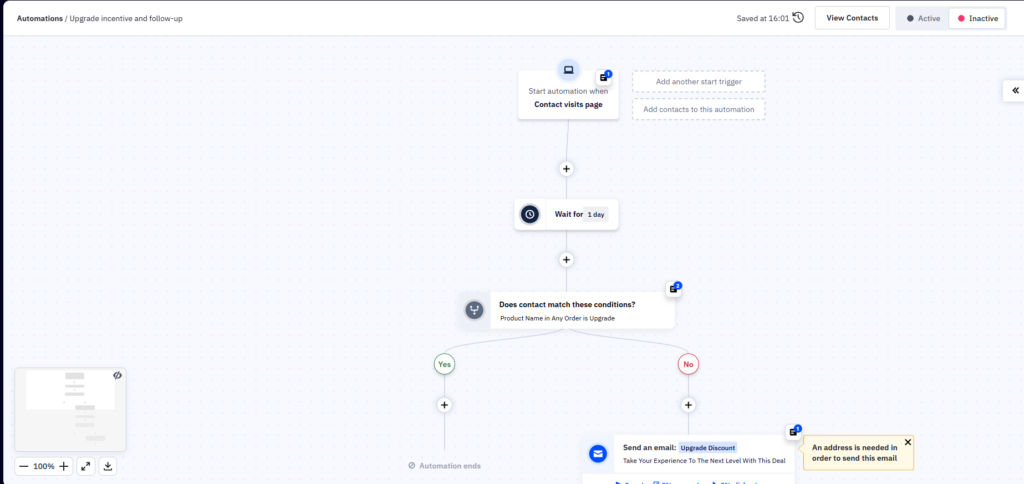
ActiveCampaign’s automation builder is the most capable in its price range. The visual canvas lets you build branching sequences based on email behavior, site visits, custom fields, tags, deal stages, and time delays — with if/else logic that routes contacts down different paths based on what they actually do. You can set goals that pull contacts out of sequences when they convert, run A/B split tests within automations, and trigger actions in third-party tools through native integrations or webhooks.
HubSpot’s automation below Professional is limited to basic linear sequences — contact enters, gets emails in order, sequence ends. There’s no branching, no behavioral routing, and no way to build the kind of logic that makes automation genuinely valuable. That functionality exists in HubSpot, but only at Professional ($800/month). For businesses comparing ActiveCampaign Plus at $49/month to HubSpot Professional at $800/month, the automation capability question answers itself.
ActiveCampaign vs HubSpot: CRM and Contact Management
Winner: HubSpot — clearly.
HubSpot’s CRM is the product the company built its reputation on. Contact records are detailed and well-organized, deal pipelines are visual and intuitive, activity tracking captures emails, calls, and meetings automatically, and sales sequences let reps automate follow-up without leaving the CRM. All of this is available on the free tier.
ActiveCampaign’s Deals CRM works for businesses that need a basic pipeline connected to their email automation. You can see deal stage, contact history, and trigger automations based on deal movement. But the depth isn’t there for sales teams managing complex pipelines — there’s no built-in calling, the activity timeline is less detailed than HubSpot’s, and the reporting on sales activity is limited compared to what HubSpot offers even on its free plan.
If sales pipeline management is a daily operational need for your team, HubSpot wins this category at every price point.
ActiveCampaign vs HubSpot: Deliverability
Winner: ActiveCampaign.
ActiveCampaign has consistently ranked among the top platforms for email deliverability in independent testing. Their infrastructure, IP warming practices, and anti-spam policies result in higher inbox placement rates compared to most competitors.
HubSpot’s deliverability is solid — it’s not a weakness in any meaningful sense — but ActiveCampaign’s track record here is slightly stronger, particularly for businesses sending high volumes to engaged lists. If inbox placement rate matters to your business (and for any email-driven revenue model, it should), ActiveCampaign’s reputation is a genuine differentiator.
ActiveCampaign vs HubSpot: Landing Pages and Forms
Winner: Tie — with caveats.
Both platforms offer landing page builders, but access varies by plan. ActiveCampaign includes landing pages from Plus plan onward. HubSpot includes landing pages on all paid plans, including Starter.
HubSpot’s landing page builder is more polished out of the box with a wider template library. ActiveCampaign’s builder is functional and sufficient for most use cases but doesn’t have the same visual variety. If landing pages are a core part of your marketing workflow, HubSpot’s Starter tier gives you access sooner and with more template options than ActiveCampaign’s entry-level plan.
For both platforms, forms integrate cleanly with their respective automation and CRM systems — a contact fills out a form, gets tagged or entered into a sequence automatically.
ActiveCampaign vs HubSpot: Reporting and Analytics
Winner: HubSpot on Professional; ActiveCampaign on mid-tier.
HubSpot’s reporting on Professional and Enterprise tiers is the most comprehensive in the category — multi-touch attribution, custom dashboards, revenue reporting, and team performance metrics across sales, marketing, and service. If you need that level of insight, HubSpot is built for it.
ActiveCampaign’s reporting covers campaign performance, automation analytics, contact engagement, and deal reporting on higher tiers. It’s more than enough for most small businesses — you’ll know what’s working and what’s not. But it doesn’t match HubSpot’s depth when you need to tie marketing activity directly to closed revenue across a multi-person team.
The practical answer: for most small businesses, ActiveCampaign’s reporting is sufficient. HubSpot’s reporting advantage only materializes when you’re at Professional tier and have the team to act on that data.
ActiveCampaign vs HubSpot: Ease of Use
Winner: HubSpot.
HubSpot is the easier platform to start with. The interface is clean, the onboarding flow is structured, and most tasks are discoverable without reading documentation. New team members can be operational within a day on basic HubSpot functions.
ActiveCampaign’s automation builder has a real learning curve. The logic canvas is powerful but requires you to think through your sequences before you build them. Most users need a few hours of hands-on time before the platform starts to feel intuitive. That investment pays off, but it’s a real upfront cost in time that HubSpot doesn’t require to the same degree.
How to Choose – ActiveCampaign vs HubSpot
Here’s how to cut through the noise on the ActiveCampaign vs HubSpot decision based on what your business actually needs:
- Email marketing and automation is your primary marketing channel
- You’re running drip sequences, behavioral triggers, lead scoring, or segmented campaigns
- You want serious automation capability without paying $800/month to unlock it
- You’re in e-commerce, SaaS, coaching, or any business where email is the conversion engine
- Your list is actively growing and you need automation that scales with it
Choose HubSpot if:
- You need a free CRM and you’re not ready to invest in marketing automation yet
- Your team has dedicated salespeople working a full pipeline every day
- You’re planning to use multiple hubs (sales + marketing + service) and want everything in one place
- You have the budget for Professional and need advanced attribution and reporting
- Ease of onboarding for a non-technical team is a priority
Consider GoHighLevel instead if:
- You’re a service business — contractor, agency, consultant, home services
- You want CRM, email marketing, automation, landing pages, SMS, and reputation management at a flat monthly rate
- You’re tired of stitching together multiple tools and paying for each separately
GoHighLevel replaces both platforms for the right use case and typically costs less than HubSpot Professional. Our GoHighLevel vs ActiveCampaign and GoHighLevel vs HubSpot breakdowns cover where it wins and where it falls short.
Getting Started with ActiveCampaign vs Hubspot
Whichever side of the ActiveCampaign vs HubSpot decision you land on, both platforms make it easy to start without a long-term commitment. The 14-day free trial includes full access to the platform. Start by building one automation — pick your most important sequence (welcome series, lead nurture, re-engagement) and build it on the canvas before evaluating. The automation builder is where the platform either clicks for you or it doesn’t, and you’ll know within a few hours.
With HubSpot: The free CRM requires no credit card and no time limit. Set up your contact database and one deal pipeline, then evaluate whether the free marketing tools cover your needs. If you hit the free tier limits and are considering Professional, get a demo before committing — the jump from Starter to Professional needs to be justified by clear use cases, not aspiration.
For connecting either platform to the rest of your stack — forms, Slack, your CRM, or other automation triggers — Make.com connects to both natively and handles the custom workflows that native integrations don’t cover.
FAQs for ActiveCampaign vs Hubspot
Is ActiveCampaign better than HubSpot for small businesses?
For email marketing and automation, yes — ActiveCampaign delivers more capability at a lower price point across every comparable tier. HubSpot is the stronger choice for CRM functionality, particularly on the free plan. The right answer depends on whether your primary need is email automation or pipeline management.
Does HubSpot have better automation than ActiveCampaign?
No. HubSpot’s automation below Professional is limited to basic linear sequences without conditional branching or behavioral triggers. ActiveCampaign offers that level of automation starting at Plus ($49/month). HubSpot doesn’t match that capability until Professional at $800/month — a 16x price difference for comparable automation depth.
Is HubSpot free actually useful in the ActiveCampaign vs HubSpot comparison?
Yes — HubSpot’s free CRM is one of the most genuinely useful free tools in the category. Contact management, deal pipelines, email tracking, meeting scheduling links, and basic reporting are all included at no cost and no time limit. The limitation is email marketing: free tier sends are capped at 2,000/month, and marketing automation is minimal. It’s a legitimate starting point for businesses that primarily need CRM, not a bait-and-switch.
What is the HubSpot pricing cliff?
The jump from Marketing Hub Starter (~$15/month) to Marketing Hub Professional (~$800/month) with no meaningful middle ground. If you need serious automation — conditional branching, A/B testing, custom reporting, smart content — you need Professional. There’s no $100–$300/month option that gets you there. This is the most important pricing fact about HubSpot for small businesses to understand before they start building on the free or Starter tier.
Can ActiveCampaign replace HubSpot?
For most small businesses, yes — particularly if email marketing and automation is the priority. ActiveCampaign’s CRM won’t match HubSpot’s depth for dedicated sales teams, but for businesses where the owner or a small team manages relationships without a formal sales process, it covers the bases without needing a second tool. Businesses that rely on HubSpot’s multi-hub integration (sales + service + operations) would need to recreate some of that coordination in ActiveCampaign.
Which is better for e-commerce: ActiveCampaign or HubSpot?
ActiveCampaign. Its native integrations with Shopify and WooCommerce, combined with behavioral triggers based on purchase history, abandoned cart, and product views, make it significantly more capable for e-commerce email automation. HubSpot has e-commerce integrations but isn’t purpose-built for the use case the way ActiveCampaign is.
How does ActiveCampaign vs HubSpot compare for agencies?
Agencies managing client accounts have different needs than internal marketing teams. ActiveCampaign allows client management on higher tiers, and its automation capabilities are strong for client campaign delivery. HubSpot offers agency partner programs and client portals, but the cost scales quickly across multiple client accounts. For agencies specifically, GoHighLevel’s white-label capabilities and flat-rate pricing model is often the more practical choice.
When should I consider GoHighLevel instead of ActiveCampaign or HubSpot?
If you’re running a service business — agency, contractor, consultant, home services — GoHighLevel consolidates CRM, email marketing, automation, landing pages, SMS, review management, and reporting into one platform at a flat monthly rate. Instead of paying for ActiveCampaign plus a separate CRM plus a landing page builder, you get everything in one system. It’s not the right fit for e-commerce or content businesses, but for service businesses it’s the most cost-efficient setup.
Verdict: ActiveCampaign vs HubSpot
The ActiveCampaign vs HubSpot decision comes down to what your business actually runs on.
If email automation is your primary growth lever — sequences, behavioral triggers, lead scoring, segmentation — ActiveCampaign is the right tool. It’s more capable at every comparable price point, the deliverability is strong, and you’re not locked into an $800/month upgrade path to access the features you actually need.
If you need a CRM first and email marketing is secondary, start with HubSpot free. It’s the best free CRM available and there’s no reason not to use it while you’re evaluating. Just know where the pricing ceiling is before you build your entire stack around it.
For service businesses looking at ActiveCampaign vs HubSpot, the honest recommendation is to look at GoHighLevel before committing to either. It’s purpose-built for the way service businesses operate, and it replaces both tools at a lower total cost.
→ Try ActiveCampaign free for 14 days → Check ActiveCampaign pricing → Try GoHighLevel